


Flood alert: Is your drinking water still safe?
The recent floods affecting several regions of France remind us of an often underestimated reality: when the water rises, drinking water disappears.
Beyond the impressive material damage, evacuated homes and cut-off roads, there is an invisible danger: the contamination of drinking water.
In this article, we will look at:
- Why floods contaminate drinking water
- Dangerous mistakes to avoid at all costs
- Emergency solutions to secure access to water
- How to prepare before the next flood
The Minister for Ecological Transition speaks of ‘record soil moisture levels not seen since 1959’ and links this to climate change.
With global warming, experts predict a 30% increase in extreme weather events by 2030.
Floods and flooding in France: A real and growing risk
When water becomes the enemy
Flooding and drinking water in France: the figures speak for themselves
-

February 2026
Major flooding in western France: four departments on RED alert (Maine-et-Loire, Charente-Maritime, Gironde, Lot-et-Garonne). In Angers, ‘levels not seen in 25 years’. Hundreds of evacuations, and above all disruption to drinking water networks in Gironde and Dordogne, with a ban on drinking tap water in several municipalities.
-
January 2026
Brittany is experiencing exceptional flooding, with more than 100 roads cut off in Ille-et-Vilaine. The authorities have issued warnings that the water is ‘unfit for consumption’ in several municipalities affected by the overflowing of the Vilaine river.
-
2025
Repeated flooding from Brittany to the south-west, with a winter that broke all rainfall records. In several flooded areas, tap water was declared undrinkable for several days, causing bottled water stocks to run out.
-
2024
The rainiest year of the century according to Météo France, with flooding in the Nord-Pas-de-Calais region. In Lille in March, 180,000 residents were left without drinking water for four days following contamination of the water supply due to flooding.


When the water rises, contamination rises with it.
It cannot be said often enough: when water rises during a flood, it never comes alone.
It sweeps away everything in its path: Sewers overflow and mix with surface water. Submerged septic tanks spill their contents. Flooded treatment plants can no longer treat water. Chemicals are dispersed.
The result? Water laden with bacteria (E. coli, salmonella), viruses (hepatitis A, norovirus), parasites, faecal matter, hydrocarbons and toxic substances. Water that may look normal. Sometimes cloudy. Sometimes even crystal clear.
But which is, in all cases, highly dangerous.
And the worst thing is that this contamination does not stop at the water flooding the streets. It seeps into the pipes. It gets back into the drinking water network when the pumping stations are submerged.
That's why the authorities systematically say: ‘Do not drink tap water.’ And that's where it gets complicated.
Because even though we live in France in 2026, when a flood occurs, access to drinking water is no longer guaranteed. And many realise too late that they are not prepared.
17 million French people live in areas at risk of flooding.

The 3 mistakes everyone makes about drinking water during floods and high water
Mistake No. 1: Relying on the appearance of the water
‘The water is clear, so it must be safe.’
No. Bacteria and viruses are invisible to the naked eye. Clear water can contain millions of pathogens. This is exactly what makes floodwater so dangerous: it does not always show signs of contamination.
NEVER trust appearances during a flood.

Mistake #2: Believing that boiling water is sufficient
True and false.
Boiling water eliminates:
bacteria, viruses, parasites.
But it does not remove:
chemicals, heavy metals, hydrocarbons.
During floods, water often contains both. Boiling kills pathogens, but the water remains chemically contaminated.

Mistake No. 3: Relying solely on bottles
The calculation seems simple: 2 litres per person per day, family of four = 8 litres per day.
Except that in reality, we need 20-30 litres per person per day (drinking + hygiene + cooking).
One week of self-sufficiency = 140 to 210 litres = 70 to 105 2-litre bottles.
And that's just for one week. Some floods last longer.
Not to mention that when the alert is issued, bottles disappear within two hours and prices skyrocket.
Bottles are a stopgap solution. They don't provide self-sufficiency.
Solutions for securing your water supply
-

Purification tablets
Chemical tablets (chlorine) to be dissolved in water.
Advantages: Compact, lightweight, eliminates bacteria and viruses.
Disadvantages: Unpleasant chlorine taste, waiting time (30 minutes to 4 hours), does not eliminate chemicals, consumable product that needs to be repurchased.
Verdict: Emergency solution for 2-3 days max.
-

Filter water bottles
Built-in filter, water is sucked through the filter.
Advantages: Portable, easy to use.
Disadvantages: Very slow flow rate (250-500mL at a time), does not filter viruses (pores too large), unsuitable for a family.
Verdict: OK for 1 person hiking, insufficient for a family.
-

Gravity filters
The water passes through filters (ceramic, charcoal) by gravity.
Advantages: Good flow rate, suitable for families, long service life.
Disadvantages: Bulky (two containers required), several hours of filtration, installation required.
Verdict: Good static solution for the home, less so for drainage.
-

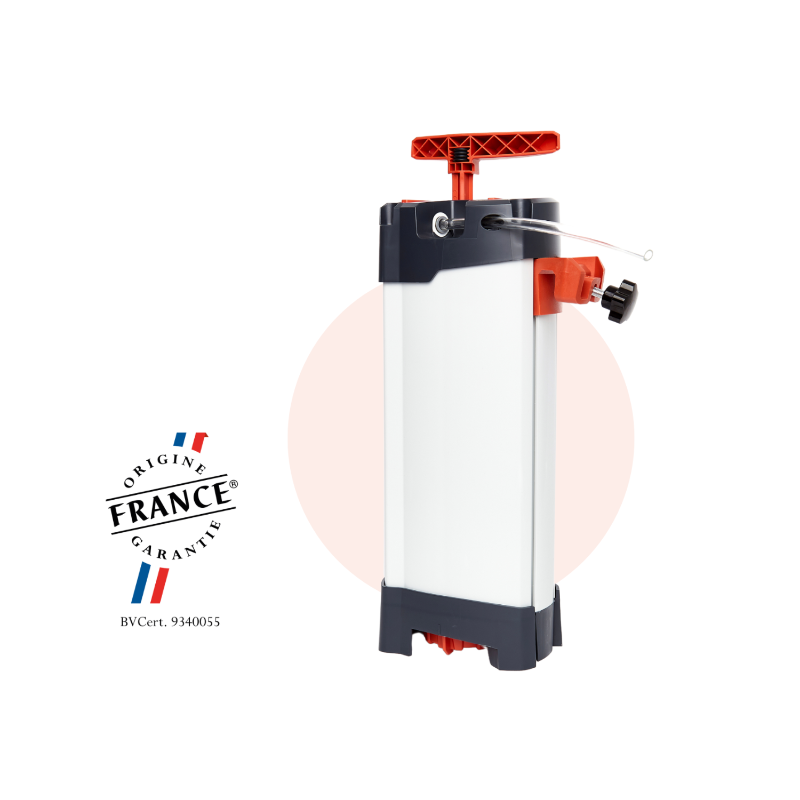
The portable ultrafiltration purifier (ORISA®)
Manual pumping through a 0.01 micron membrane.
Advantages: Instant filtration of bacteria and viruses (certified by the Pasteur Institute) by pumping, 3L/minute - 180L/hour, portable and no electricity required.
Disadvantages: Initial investment, manual pumping.
Verdict: The most comprehensive solution for true family self-sufficiency.




Why NGOs use ORISA® in emergency situations
The Red Cross, Solidarités International, Doctors Without Borders, and Secours Islamique France use ORISA® in their humanitarian missions for one simple reason:
in a crisis situation, there is no room for approximation.
Absolute reliability (certified by the Pasteur Institute and WHO)
- Total autonomy (no electricity, chemicals, or network required)
- Speed (drinking water in minutes, not hours)
- Adaptable volume (180L/hour if needed)
- 600,000 people in 50 countries rely on this technology for their survival.
And what works in the Sahel or Latin America also works in France when the sewers overflow.


