une femme boit de l'eau filtrer par le purificateur d'eau orisa

Why are filtration tests essential for ensuring water is truly safe to drink?

When it comes to water filtration, one question almost always comes up:

does it really work?

Because clear water isn’t necessarily safe to drink. It may be transparent, odourless and pleasant to drink… yet still contain invisible microorganisms. It is precisely for this reason that filtration cannot be judged by the naked eye.

The only reliable way to assess a water purifier is to put it to the test of science.

Filtering water isn’t just about making it look better

Filtration is often associated with improving the water’s appearance. But in reality, that’s not the main issue.

The real challenge lies in removing what you cannot see: bacteria, viruses and microbiological contaminants.

And that’s where it all comes down to.

Because whilst some systems improve the water’s appearance, others actually make it safe to drink.

Tests designed to replicate the worst-case conditions
To measure a water purifier’s true effectiveness, it is not enough to test it on clean water.

The most rigorous testing protocols, particularly those of the WHO, replicate real-world conditions using different types of water and high levels of contamination. This assessment is recognised worldwide as the gold standard for the humanitarian sector and governments.

These tests include, in particular:

  • clear water (rainwater, groundwater);
  • heavily polluted water (surface water, river water);
  • high levels of bacteria and organic matter.

The aim is simple: to replicate the most challenging conditions to ensure reliability.

Performance is assessed regularly over several hundred litres. To understand exactly how these tests are designed, you can consult the official protocol:

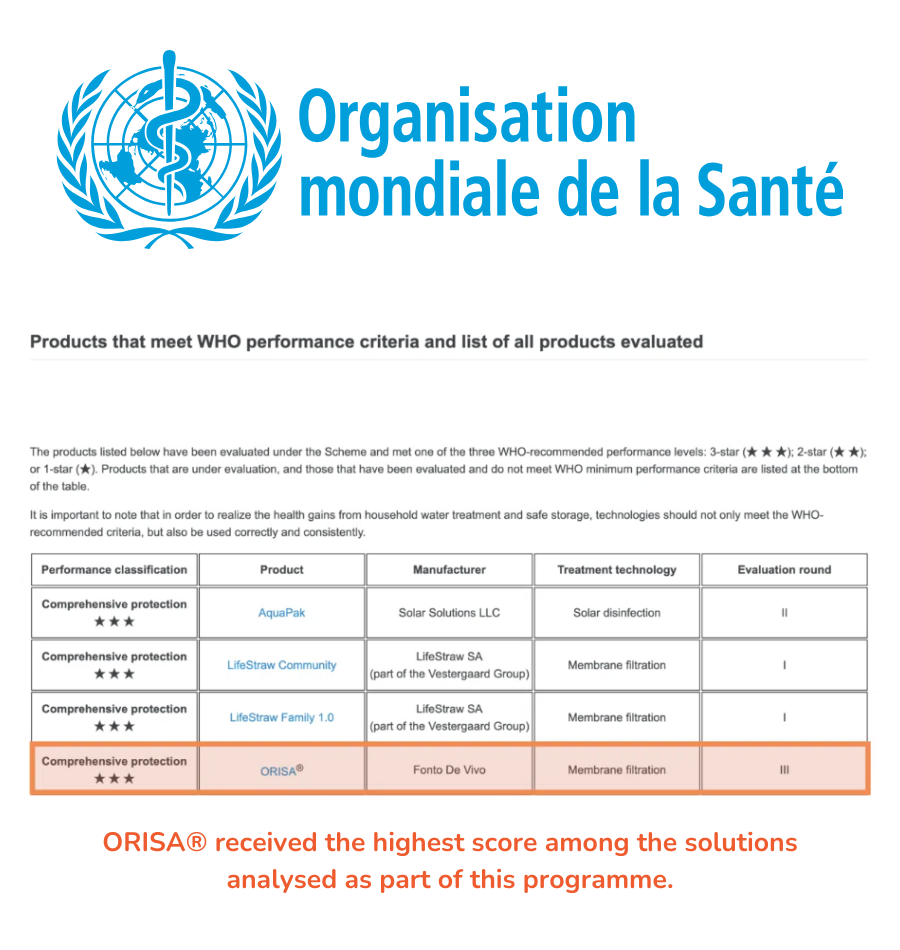
ORISA received the highest score among the solutions analysed as part of the OMS WHO programme
WORLD HEALTH ORGANISATION

The highest standard: WHO 3-star certification

As part of its international programme for the evaluation of water treatment technologies (HWTS), the WHO has defined several performance levels. The highest level corresponds to “complete protection”, represented by a 3-star certification.

Achieving this level means that the system is capable of significantly reducing all microbiological contaminants, including bacteria and viruses, even in highly degraded water conditions. Unlike independent laboratory tests, this certification is based on a comprehensive protocol that also incorporates performance against viruses, with a minimum requirement of a LOG 5 reduction (i.e. 99.999% removal).

In other words, validation of efficacy against viruses is included in the WHO’s comprehensive assessment.

View the certification
Pasteur Institute - IFTS

What independent laboratory tests reveal

In addition to WHO certification, independent tests provide concrete evidence of effectiveness.

The ORISA® water purifier has been tested against a particularly challenging bacterium: Campylobacter jejuni. The results show an elimination rate of over 99.9999992%, representing a reduction of more than 8 LOG.

You can view the report on the bacterial retention tests carried out by the IFTS (French Institute of Separation Techniques), with analyses conducted by the Pasteur Institute:

View the test results

Understanding what the reduction levels (LOG 5, LOG 8) mean

This type of data may seem technical, but it is actually very concrete.

A reduction of LOG 8 means that, out of 100 million bacteria present in the water, potentially fewer than one remain after filtration. This is the level of performance measured for bacteria during independent laboratory tests (IFTS / Institut Pasteur).

For viruses, the requirements are expressed differently: a Log 5 reduction corresponds to the elimination of 99.999% of viruses, leaving just 1 virus in 100,000. This level is the one required and validated under the WHO protocol to obtain 3-star certification, as is the case for the ORISA® water purifier.

  • LOG 8 (bacteria) → near-total elimination, validated by independent tests
  • LOG 5 (viruses) → a very high level, validated under the WHO certification scheme

These two complementary performance levels cover all microbiological risks and guarantee truly safe water.

Test conditions that closely resemble real-world use
The tests are carried out under realistic conditions to ensure a reliable measurement, without any approximations.

In practice, the contaminated water is circulated through the filter at a flow rate comparable to that of everyday use (approximately 0.8 L/min), rather than at a reduced flow rate that would artificially facilitate filtration.

The analysis is not limited to a single sample. The entire filtered volume is examined. This avoids biases associated with partial sampling and provides a comprehensive view of performance.

Finally, the detection method is extremely sensitive: it can identify the presence of a single bacterium in the analysed volume. In other words, even minimal residual contamination would be detected.

This high standard ensures that the results are not based on ‘facilitating’ conditions, but on rigorous measurement that closely reflects real-world usage.

And in practice? Proven results

Performance was also tested using natural water sources: rainwater, well water and raw water.

Performance is not limited to laboratory conditions. It has also been tested in real-world situations using natural water sources: rainwater, well water and even raw water.

Unlike water used in laboratories, these water sources exhibit significant variability. Its quality depends on the environment, climatic conditions, the presence of organic matter, or even occasional contamination. It therefore serves as an excellent indicator of performance in real-world use.

Samples were taken and analysed in the laboratory after filtration. The results show microbiologically safe water, with no indicator bacteria such as coliforms, Escherichia coli or enterococci.

Beyond microbiology, the physico-chemical parameters also confirm the quality of the water produced: very low turbidity, clear water, with no alteration in taste or smell. This point is essential: it is not merely a matter of theoretical performance, but of results observed under real-world conditions of use.

In other words, the system does not merely function well in the laboratory: it demonstrates its ability to make water from natural sources drinkable in a variety of contexts.

Report on the analysis of different types of water filtered by the ORISA® water purifier

Following filtration, analyses reveal that the water is microbiologically safe, with no trace of indicator bacteria such as E. coli or enterococci. It also exhibits excellent visual and organoleptic quality: clear, stable, with no change in taste or smell, and in compliance with the quality requirements for water intended for human consumption.

These results are crucial, as they demonstrate that performance is not limited to an experimental setting. It is also verified under real-world conditions, using natural water.

What this means for you in practical terms

Behind these technical specifications lies a very simple issue: being able to trust the water you drink.

Choosing a water purifier is a decision that directly affects your safety, as well as your independence and peace of mind. It means knowing that, even outside a controlled water supply network, you can rely on a trustworthy solution.

And in this area, trust cannot be based on a promise. It is based on evidence.

The ORISA® water purifier: filtration designed for real-world use

ORISA® stands out not only for its performance, but also for the consistency of its approach.

Each element reinforces the others: rigorous independent testing, international certification to the highest standards, and performance measured in the laboratory and confirmed in the field. Together, this forms a solid demonstration, both scientific and practical.

In the field, our water filtration equipment has been used to combat cholera, in programmes where severe waterborne diseases are prevalent (refugee camps, health centres, schools, households) and by numerous organisations worldwide. This proves its overall performance, both in retaining pathogens and in its robustness, ensuring daily access to safe water from any source of raw surface water.

This approach addresses a simple reality: you do not always have access to drinking water, but you must be able to make it safe, wherever you are.

Not all filtration systems are created equal. Some merely improve the water’s appearance.

Others go a step further and actually make it safe to drink. The difference lies in the ability to demonstrate this rigorously. And when it comes to water, such proof can only be scientific.